

It might surprise you to learn that we humans spend over 85% of our time indoors—at home, in offices, schools & colleges, commercial spaces, or leisure venues. Our journey is essentially from one building to another. While buildings are designed to protect us from the elements of nature, there’s another increasingly pressing issue in urban environments: noise.
The constant blare of horns, the hum of traffic, construction work, ceremonial processions, and loudspeakers—Indian cities are a vibrant mix of sounds, not all of them welcome.
Inside our built spaces, we crave calm. Whether it’s to work, focus, rest, or relax, creating peaceful indoor environments is critical. One way to achieve this is by designing efficient building envelopes that block unwanted sound.
Let’s explore how glass, often seen as a transparent and elegant partition, can be optimized to cut noise transmission.

Double-layered Insulated Glass Blocks External Noise on Building Facades
This system uses two or more glass panes separated by air or inert gas-filled cavity, effectively reducing sound transmission. The layered glass-cavity configuration creates a lag in sound waves, making it harder for noise to pass through.
Key Consideration: The frame is just as important—it must be robust and well-insulated to support the glass assembly and prevent sound leakage at the joints.
Also read Insulated Glass Technology and its Applications

Laminated Glass Reduces Sound and Enhances Safety in a Sleek Profile
Laminated glazing involves two or more layers of glass bonded with a polyvinyl butyral (PVB) interlayer. These layers dampen sound vibrations, providing effective acoustic control.
In addition to noise reduction, laminated glass offers:
Also read A Complete Guide About Laminated Glass
If budget or design constraints don’t allow for layered systems, opting for thicker glass can still make a difference.
For example, 12mm glass offers better sound insulation than 6mm, simply due to the additional thickness. However, thicker glass is heavier and requires strong, stable framing to maintain performance.
Also Read Experience Quiet Luxury: The Role of Acoustic Comfort in Your Home
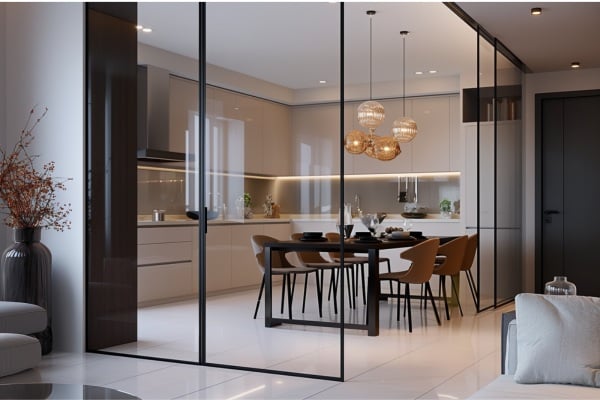
Each Glass Needs Airtight, Well-sealed Frames to Block Noise Effectively
Frames are often the weakest link in noise control. Even with the best glass, poorly designed or loosely fitted frames allow sound to leak through.
Opt for materials like uPVC or thermally broken aluminium, and ensure:

Insulated Walls with Glass to Create a Complete Soundproof Envelope
While this blog focuses on glass, it’s important to remember that sound travels through all parts of the envelope.
Thicker or insulated external walls can significantly reduce noise transmission. Consider techniques like:
In urban settings, noise control is essential for quality of life. Understanding the types of sounds affecting your space—traffic, street activity, machinery—and choosing the right glazing and wall solutions can help you reclaim peace indoors.
Get expert guidance, especially when planning sound-sensitive spaces like bedrooms, meeting rooms, or meditation areas. After all, there’s little point in being indoors if it still feels like sitting by the roadside.
Keep noise at bay and enjoy calm, comforting interiors—all with the right glass and thoughtful design.
Also Read Learn how glass can become an integral part of the design and structure
How effective is glass in reducing noise transmission?
Glass can be highly effective in reducing noise when the right type is used. Options like insulated glazing units (IGUs) and laminated glass with PVB interlayers are specifically designed for acoustic insulation and significantly reduce sound transmission in indoor environments.
What is the difference between laminated glass and insulated glass for soundproofing?
Laminated glass uses layers of glass bonded with a PVB interlayer that dampens vibrations and reduces noise. Insulated glass (double-glazed) features two glass panes separated by an air or gas-filled cavity that disrupts sound waves. Laminated glass is thinner and offers safety benefits, while insulated glass provides better thermal and acoustic performance but requires bulkier frames.
Why is frame quality important in reducing noise through glass walls?
Even the best acoustic glass won’t perform well if the frame allows sound leakage. Airtight, well-sealed frames made from uPVC or thermally broken aluminium with proper gaskets and professional installation are necessary for noise control.
What kind of noise can acoustic glass reduce?
Acoustic glass can reduce environmental noise, such as traffic sounds, construction noise, horns, street activity, and loudspeakers, making it ideal for urban homes, offices, and hotels.
Rasya is an architect and sustainability consultant based in Delhi. With over 10 years of experience in core architecture, and exposure to working in diverse contexts including India, Belgium and Ethiopia, she brings a multi-disciplinary approach to her work. Read More